
Superior Heat EfficiencyCompact Design & Versatile Applications
OnePHE’s plate heat exchangers (PHEs) deliver exceptional heat transfer efficiency, reducing energy costs for industrial processes, renewable energy, and HVAC systems.
Plate Heat Exchangers
OnePHE’s plate heat exchangers (PHEs) feature precision-profiled plates with inlet and outlet holes, offset at 180° to form efficient flow channels. Fitted with high-quality gaskets, our OEM-compatible PHEs ensure reliable sealing, separating media for optimal heat transfer in industrial, HVAC, and energy applications.
Gasketed plate heat exchangers
Keywords
Always the right plate for your application
Gasketed Plate Heat Exchangers
Tailored Solutions for Industrial and HVAC Applications
OnePHE’s gasketed plate heat exchangers (PHEs) consist of precision-stamped plates and gaskets, secured in a frame with clamping bolts for uniform pressure. Designed for volume flows of 0.5–4,500 m³/h and heat exchange surfaces of 0.04–3 m² per plate, they offer OEM-compatible reliability, easy maintenance, and the flexibility to add plates for increased capacity, ideal for diverse industrial needs.
Advantages of Gasketed Plate Heat Exchangers
- High thermal efficiency with OptiFlow, Bypass Stop, and Best Wave systems for optimal heat transfer.
- Compact design reduces investment costs, suitable for high-viscosity or contaminated fluids.
- Maintenance-friendly with clip-on gaskets and turbulent flow for efficient self-cleaning.
- Versatile applications with titanium plates for demanding environments like seawater cooling.
Gasketed plate heat exchangers
| Category | Details |
|---|---|
| Product Features |
|
| Category | Details |
|---|---|
| Technical Specifications |
|
Brazed plate heat exchangers
Keywords
The universal solution for industrial applications and building technology
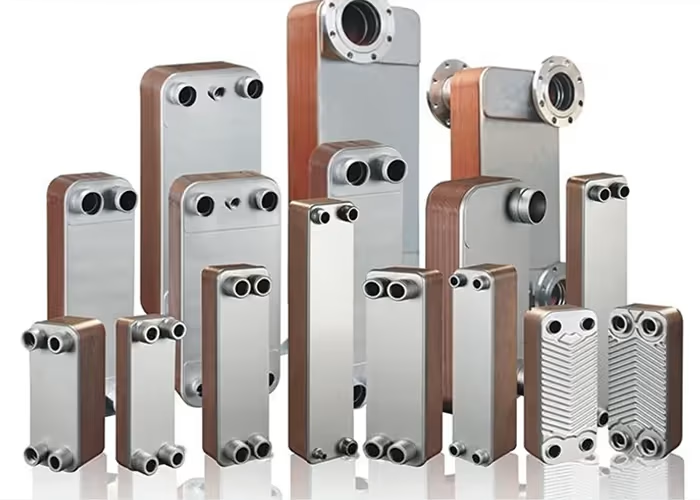
Brazed plate heat exchangers are made up of stamped stainless steel plates that are brazed in a vacuum process to form a pressure-resistant unit, in copper or nickel depending on the requirements of the application. They can therefore be operated at high pressures and temperatures and they have a compact design. Advantages of brazed plate heat exchangers- High thermal capacity: diagonal media routing and turbulators in the flow gaps.
- Highly resilient thanks to seam brazing rather than spot brazing
- Compact design also suitable for high-viscosity media because of high heat transfer
- Direct connection to the power unit without any additional holders thanks to elongated end plate
Series of brazed plate heat exchangers
| Feature | Details |
|---|---|
| High Thermal Efficiency | Diagonal media routing and turbulators in flow gaps ensure superior heat transfer, ideal for high-viscosity media. |
| Robust Construction | Seam-brazed stainless steel plates (copper or nickel) form a pressure-resistant unit, ensuring OEM-compatible durability. |
| Compact Design | Small footprint saves space, with direct power unit connection via elongated end plates, no additional holders needed. |
| Versatile Applications | Suitable for hydraulics, motor cooling, heat recovery, HVAC, and air-conditioning, with TPL and GPL/NPL series options. |
| Parameter | TPL Series | GPL/GPLK/NPL/NPLK Series |
|---|---|---|
| Heat Exchange Surface/Plate | 0.035–0.286 m² | Not specified |
| Max. Operating Pressure | 36 bar | 16–30 bar |
| Max. Operating Temperature | +200°C | +200°C |
| Brazing Material | Copper | Copper (GPL/GPLK), Nickel (NPL/NPLK) |
| Safety Features | Available as safety heat exchanger with double wall for enhanced media separation. | |